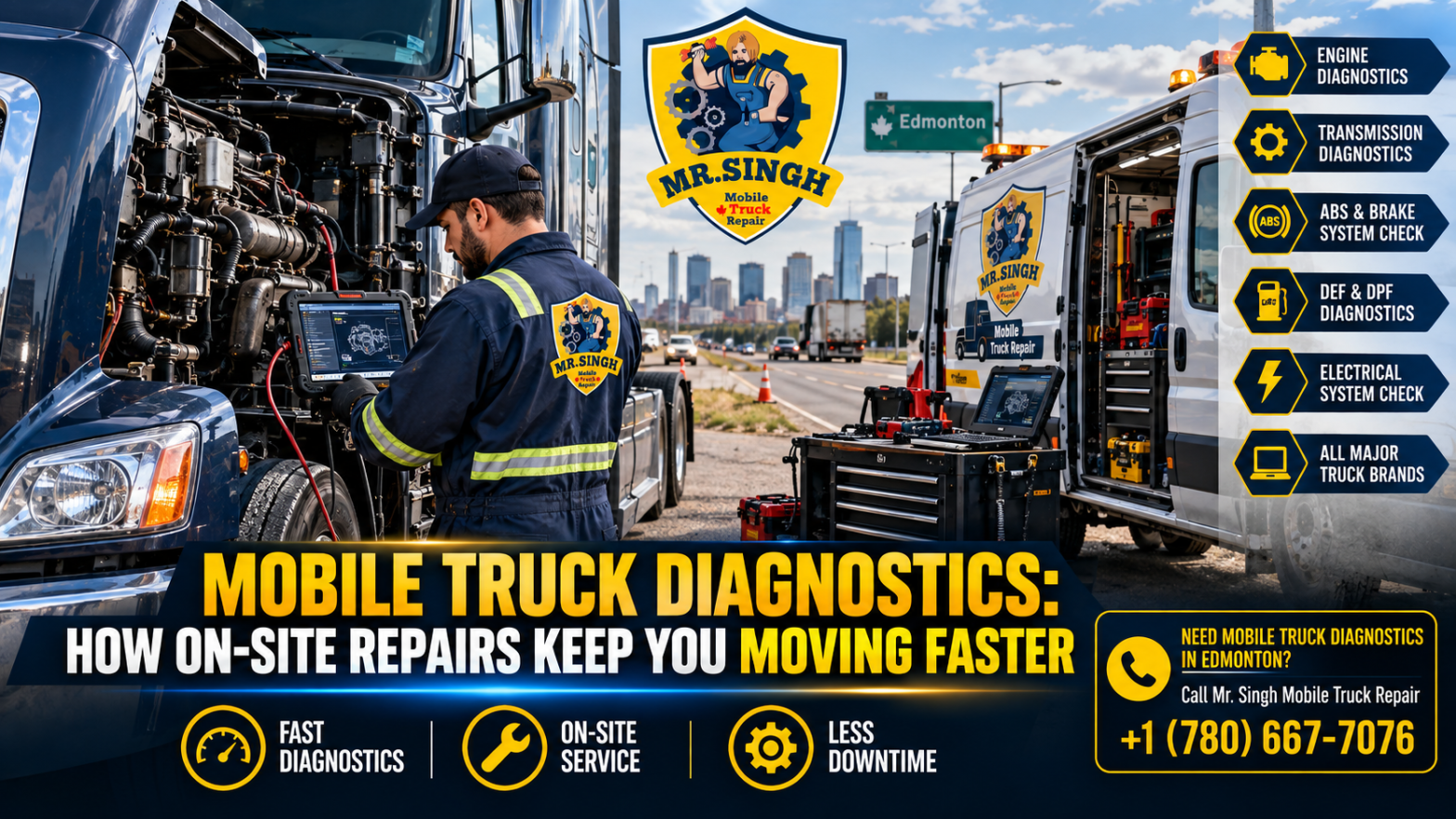
A truck breakdown can quickly become an expensive business problem. When a commercial truck stops working, the issue is not limited to the repair itself. Drivers may lose working hours, deliveries can be delayed, and fleet schedules can be disrupted.
This is where mobile truck diagnostics can make a major difference.
Instead of immediately arranging a tow to a repair facility, a qualified mobile technician can travel to the truck and diagnose the problem where it is parked. The technician can use diagnostic equipment, visual inspections, testing procedures, and mechanical knowledge to identify the likely cause of the failure.
For trucking companies, owner-operators, and commercial vehicle operators in Edmonton, this approach can provide a practical way to respond to unexpected mechanical and electronic problems.
Mr. Singh Mobile Truck Repair provides mobile truck repair support in Edmonton for customers who need professional assistance at their location.
What Are Mobile Truck Diagnostics?
Mobile truck diagnostics is the process of identifying mechanical, electrical, and electronic problems at a truck’s current location.
Modern heavy-duty trucks contain multiple electronic control systems. These systems monitor engine performance, emissions, transmission operation, braking systems, and other vehicle functions.
When a fault occurs, the truck may display a warning light or diagnostic trouble code.
A mobile technician can connect appropriate diagnostic equipment to the vehicle and interpret available fault information. However, a diagnostic code does not always identify the entire repair. A professional inspection is often needed to determine the actual cause.
What Can a Mobile Diagnostic Service Check?
Depending on the truck and equipment available, a truck diagnostics service may help investigate:
- Engine faults
- Transmission problems
- Electrical issues
- Starting and charging problems
- ABS warning lights
- DEF system faults
- DPF-related warnings
- Sensor problems
- Cooling-system concerns
- Fuel-system issues
- Emissions-system faults
- Communication errors between vehicle control modules
The exact diagnostic process depends on the truck manufacturer, model, fault symptoms, and available diagnostic equipment.
Why On-Site Truck Diagnostics Matter
A diagnostic problem does not always mean that a truck needs a major repair.
For example, a warning light may result from a sensor, wiring issue, system fault, or another component. Proper diagnostics help determine what should be investigated before parts are replaced.
This can prevent unnecessary repairs and help technicians create a more informed repair plan.
Faster Problem Identification
Traditional troubleshooting may require moving the truck to a repair facility before inspection can begin.
With on-site truck repair, a technician can start the diagnostic process at the truck’s current location.
This can be particularly useful when the truck is parked at a job site, fleet yard, roadside location, or other accessible area.
Less Dependence on Towing
If a truck can be safely inspected and repaired at its location, towing may not be necessary.
Avoiding a tow can save time and reduce an additional service expense. However, safety comes first. A truck with a serious mechanical or safety-related failure may still require towing or specialized transportation.
Reduced Operational Downtime
For commercial vehicles, downtime can affect schedules and revenue.
The American Trucking Research Institute has published research examining the costs associated with truck operating expenses and downtime-related business impacts.
The exact financial impact varies by fleet, vehicle, route, cargo, and duration of the breakdown.
How Mobile Truck Diagnostics Work
A professional diagnostic visit usually follows a structured process.
1. Gather Information
The technician first asks about the symptoms.
Important information may include:
- Warning lights
- Unusual sounds
- Loss of power
- Starting difficulties
- Smoke
- Fluid leaks
- Recent repairs
- Changes in fuel economy
- Transmission behavior
- Previous diagnostic codes
This information gives the technician a starting point.
2. Perform a Visual Inspection
The technician examines the truck for visible problems.
This may include checking wiring, hoses, connectors, fluid levels, belts, components, and signs of damage or leakage.
Visual inspection is important because an electronic code alone may not explain the complete problem.
3. Connect Diagnostic Equipment
Where appropriate, the technician connects compatible diagnostic equipment to the truck.
The equipment may retrieve diagnostic trouble codes and other available information from vehicle control systems.
4. Interpret the Results
A diagnostic code is a clue, not always a final diagnosis.
The technician considers the code alongside the truck’s symptoms, inspection findings, and system behavior.
This approach can help avoid replacing a component simply because a code points toward that system.
5. Recommend the Next Step
After diagnosis, the technician can explain what needs attention.
Depending on the issue, the next step may involve:
- On-site repair
- Component replacement
- Electrical troubleshooting
- Further testing
- Preventive maintenance
- Towing to a specialized facility
Mobile Diesel Diagnostics for Heavy-Duty Trucks
Diesel engines are widely used in commercial transportation because they are designed for demanding operating conditions.
However, diesel systems can develop complex mechanical and electronic problems.
Mobile diesel diagnostics can help investigate issues involving engine performance, fuel systems, sensors, emissions systems, and other components.
Engine Performance Problems
A truck may experience:
- Reduced power
- Rough operation
- Hard starting
- Excessive smoke
- Poor acceleration
- Unusual engine noises
These symptoms can have several possible causes.
Diagnostics help narrow the problem before repair decisions are made.
DEF and Emissions Problems
Modern diesel trucks use emissions-control systems that can include diesel exhaust fluid (DEF) and diesel particulate filters (DPF).
A warning related to these systems should not automatically be ignored.
Continuing to operate a vehicle with an unresolved emissions-system fault may lead to additional problems or operating restrictions, depending on the vehicle and fault.
Electrical and Sensor Problems
Modern trucks depend heavily on electronic sensors and control modules.
A damaged wire, poor connection, failed sensor, or communication issue can create warning messages or affect vehicle operation.
Professional diagnostics can help determine whether the problem is mechanical, electrical, electronic, or a combination.
On-Site Truck Repair vs. Traditional Shop Repair
Both mobile and shop-based repairs have a role in commercial vehicle maintenance.
The right option depends on the problem.
| Situation | On-Site Service | Shop Service |
| Truck cannot easily move | Often useful | May require towing |
| Diagnostic inspection | Often possible | Possible |
| Minor repairs | Often possible | Possible |
| Major component replacement | May be limited | Often more suitable |
| Specialized equipment required | Depends on service | Often available |
| Emergency roadside issue | Convenient | Less immediate |
The goal is not to replace every repair shop visit with mobile service. Instead, mobile truck repair provides another option when traveling to a shop is impractical or unnecessary.
Common Signs Your Truck Needs Diagnostics
Truck operators should pay attention to changes in vehicle behavior.
Warning Lights
Check-engine, ABS, transmission, or emissions warnings should be investigated rather than ignored.
Loss of Engine Power
Reduced power can have many causes, including fuel, air, electrical, turbocharger, sensor, or emissions-system problems.
Starting Problems
Repeated difficulty starting may indicate a battery, starter, electrical, fuel, or engine-related issue.
Unusual Sounds
New knocking, grinding, whining, hissing, or other unusual sounds can indicate a developing mechanical problem.
Reduced Performance
Changes in acceleration, fuel consumption, shifting, or engine response may justify a diagnostic inspection.
How Diagnostics Can Help Prevent Bigger Repairs
Diagnostics are not only useful after a truck stops running.
They can also support preventive maintenance.
A recurring warning light or performance change may indicate a developing problem. Finding the issue earlier can give a fleet operator an opportunity to address it before it causes a larger failure.
According to maintenance research from the U.S. Department of Energy and other transportation organizations, preventive maintenance and timely vehicle servicing can support vehicle reliability and operational efficiency.
Actual savings depend on the vehicle, operating conditions, maintenance program, and type of failure.
Mobile Truck Repair Edmonton: Local Benefits
Edmonton is an important transportation and commercial hub in Alberta. Trucks operating in and around the city may travel between warehouses, construction sites, industrial areas, highways, distribution facilities, and surrounding communities.
A truck breakdown in one location may create problems far beyond the vehicle itself.
For Edmonton operators, mobile truck repair Edmonton services can provide location-based assistance when a truck cannot easily reach a conventional repair facility.
Useful for Fleets
Fleet operators may have multiple trucks working at different locations.
An on-site technician can inspect a vehicle at a fleet yard or another accessible location, depending on the service required.
Useful for Owner-Operators
Owner-operators often depend directly on their trucks for income.
When a truck develops a mechanical or electronic problem, reducing unnecessary travel and diagnostic delays can be valuable.
Useful During Unexpected Breakdowns
Roadside failures can happen without warning.
A mobile repair service provides an option for requesting professional assistance without automatically arranging transportation to a shop.
What Information Should You Provide When Calling?
Providing accurate information can help the technician prepare for the visit.
Have the following details available when possible:
- Truck make and model
- Model year
- Engine type
- Current location
- Warning lights
- Diagnostic codes
- Description of symptoms
- Whether the truck starts
- Whether the truck can move safely
- Recent repairs or maintenance
Photos or videos of warning messages may also help when appropriate.
The more accurate the initial information, the easier it may be to prepare for the diagnostic visit.
Why Choose Professional Mobile Diagnostics?
Heavy-duty trucks require specialized knowledge and appropriate diagnostic tools.
Professional service can help distinguish between symptoms and underlying causes.
A qualified technician can also determine whether a problem is suitable for on-site repair or whether the truck requires additional repair resources.
This distinction matters because not every breakdown should be repaired at the roadside.
Safety should always take priority over convenience.
Frequently Asked Questions
What are mobile truck diagnostics?
Mobile truck diagnostics is the process of inspecting and testing a truck at its current location to identify mechanical, electrical, or electronic faults. A technician may use diagnostic equipment, visual inspection, system testing, and vehicle symptoms to determine the likely cause and recommend the appropriate repair.
Why use a mobile truck repair service?
A mobile truck repair service allows a technician to travel to the truck instead of requiring the vehicle to reach a repair shop first. This can be useful when a truck is disabled, parked at a fleet yard, or experiencing a problem that can potentially be diagnosed or repaired on-site.
How does mobile diesel diagnostics work?
Mobile diesel diagnostics typically begins with a review of the truck’s symptoms and warning messages. The technician then performs an inspection and may connect compatible diagnostic equipment to retrieve fault information. The results are evaluated with physical findings to determine the likely cause and recommended next step.
When should I request truck diagnostics?
Request truck diagnostics when a truck displays warning lights, loses power, develops unusual sounds, experiences starting problems, runs poorly, or shows other unexpected changes. Early diagnosis can help identify potential problems before they develop into more serious failures or cause extended vehicle downtime.
Who needs mobile truck repair in Edmonton?
Mobile truck repair in Edmonton can benefit owner-operators, trucking companies, fleet managers, construction businesses, delivery operators, and other commercial vehicle users. It is particularly useful when a truck cannot conveniently travel to a repair facility or when an on-site inspection can be performed safely.
Conclusion
Truck downtime can affect drivers, deliveries, fleet schedules, and operating costs. Mobile truck diagnostics provide a practical way to investigate many mechanical and electronic problems at the truck’s current location.
With the right diagnostic process, operators can better understand warning lights, performance problems, electrical faults, diesel-system issues, and other truck concerns.
For businesses and owner-operators looking for mobile truck repair Edmonton services, choosing an experienced technician can help simplify the response to unexpected vehicle problems.
If your truck needs diagnostics, troubleshooting, or on-site repair assistance in Edmonton, contact Mr. Singh Mobile Truck Repair.
Call Mr. Singh Mobile Truck Repair today at +1 (780) 667-7076 to discuss your truck diagnostic or mobile repair needs.