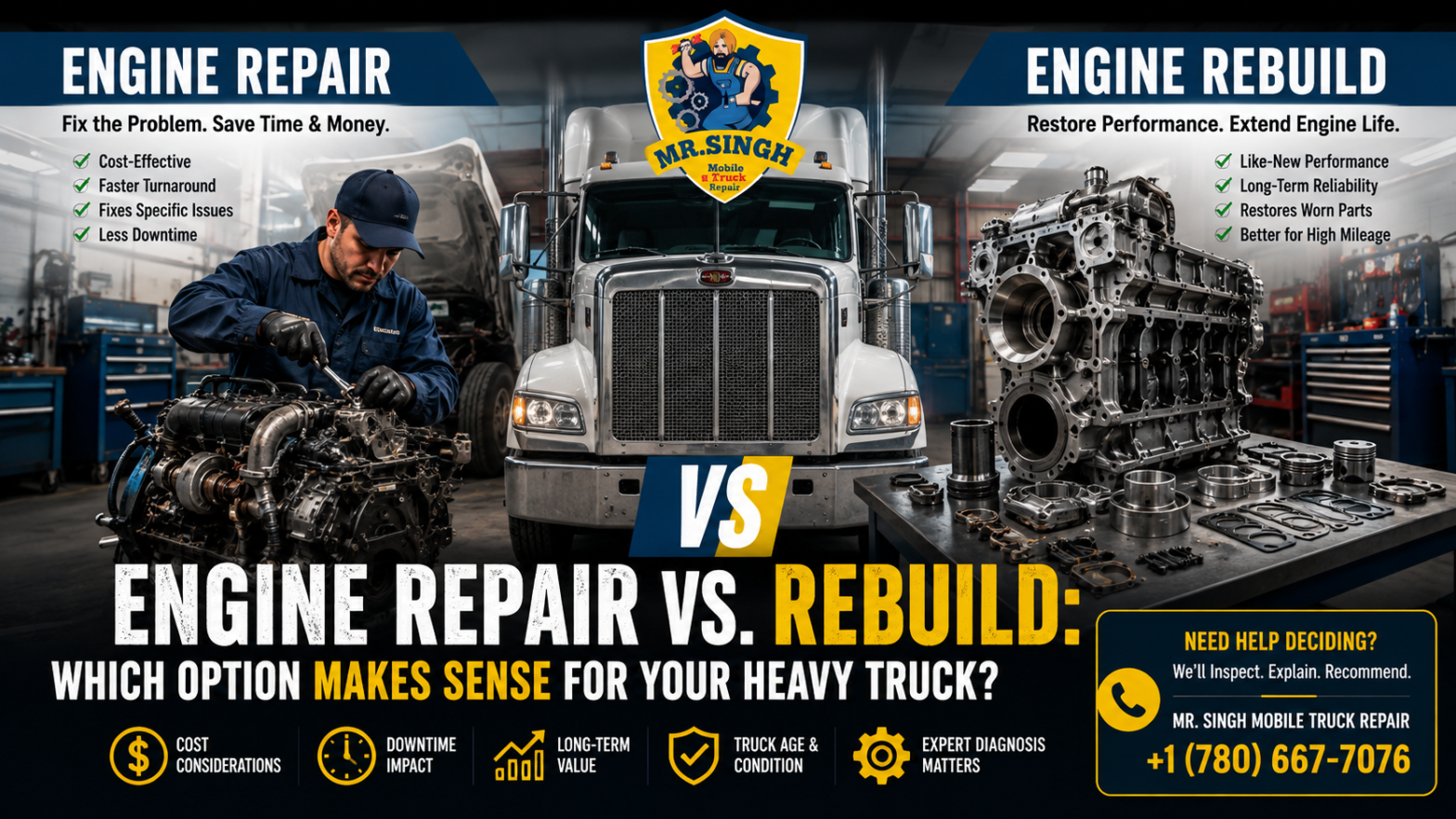
A heavy-duty truck engine represents a major investment. When performance drops or a serious engine problem develops, choosing the wrong repair strategy can lead to unnecessary expenses and additional downtime.
Truck owners often face one important question: Should the engine be repaired, or does it need a complete rebuild?
The answer is not always obvious.
A truck may have symptoms such as excessive smoke, low power, hard starting, abnormal engine noise, high oil consumption, or overheating. These symptoms can result from a relatively small component failure or significant internal engine damage.
That is why professional diagnosis matters.
Before choosing heavy truck engine repair or a heavy truck engine rebuild, technicians should identify the underlying problem and determine how much damage has occurred.
What Is Heavy Truck Engine Repair?
Heavy truck engine repair involves fixing or replacing specific components that have failed or become damaged while keeping the core engine assembly in service.
The goal is to restore proper engine operation without rebuilding the entire engine.
Common Engine Repairs
Depending on the symptoms and diagnosis, truck engine repair may involve:
- Fuel injector replacement
- Turbocharger repair or replacement
- Gasket replacement
- Cooling-system repairs
- Water pump replacement
- Thermostat replacement
- Sensor replacement
- Fuel-system repairs
- Electrical troubleshooting
- Valve-related repairs
- Belt and hose replacement
- Oil leak repairs
- Intake or exhaust repairs
- Aftertreatment-related diagnosis
A localized problem does not automatically mean the engine needs a rebuild.
For example, a truck experiencing overheating may have a damaged water pump, blocked radiator, failed thermostat, coolant leak, or another cooling-system issue. Replacing the complete engine would be unnecessary if the internal components remain healthy.
When Repair Makes Sense
Heavy truck engine repair is often appropriate when:
- The engine has good overall compression.
- Internal components are in acceptable condition.
- Damage is limited to specific components.
- Repair costs are reasonable compared with rebuilding.
- The truck’s remaining service life justifies the repair.
The technician should evaluate these factors before recommending a major engine job.
What Is a Heavy Truck Engine Rebuild?
A heavy truck engine rebuild involves disassembling an engine and inspecting its major internal components.
Depending on the engine’s condition, worn or damaged parts are repaired or replaced before the engine is reassembled.
A rebuild can address wear that cannot be solved through a simple component replacement.
What Does an Engine Rebuild Include?
The exact process varies by engine and damage. However, a rebuild may involve inspection or replacement of:
- Pistons
- Piston rings
- Cylinder liners
- Bearings
- Crankshaft components
- Connecting rods
- Gaskets and seals
- Valves
- Cylinder head components
- Oil pump
- Timing components
Machining may also be required if certain internal surfaces are outside acceptable specifications.
The objective is to restore the engine’s internal condition and provide additional service life.
When Does an Engine Need a Rebuild?
A rebuild becomes more appropriate when an engine has extensive internal wear or damage.
Common indicators include:
Excessive Oil Consumption
High oil consumption can sometimes result from relatively simple problems. However, worn piston rings, cylinder liners, or other internal components can also contribute.
A technician should determine the actual cause before deciding on a rebuild.
Low Compression
Compression problems can affect combustion, power, fuel efficiency, and starting performance.
If compression loss results from significant internal wear, rebuilding may be necessary.
Severe Blow-By
Blow-by occurs when combustion gases pass into the crankcase.
Some blow-by is normal in diesel engines, but excessive blow-by may indicate significant wear involving piston rings, liners, or related components.
Knocking or Abnormal Engine Noise
Serious internal noises can indicate problems involving bearings, pistons, connecting rods, or other components.
Operating an engine with severe internal damage can make the eventual repair more expensive.
Major Internal Damage
If the engine has suffered substantial damage, repairing individual parts may not provide the most practical long-term solution.
In such cases, a heavy truck engine rebuild may be more appropriate.
Heavy Truck Engine Repair vs. Engine Rebuild
The biggest difference is the scope of the work.
| Factor | Engine Repair | Engine Rebuild |
| Scope | Specific component or system | Major internal engine work |
| Engine disassembly | Usually limited | Extensive |
| Cost | Often lower | Usually higher |
| Downtime | Generally shorter | Generally longer |
| Best for | Localized failures | Significant internal wear |
| Goal | Fix a specific problem | Restore internal engine condition |
| Parts replaced | Selected components | Multiple internal components |
This comparison does not mean repair is always better than rebuilding.
The correct option depends on the engine’s actual condition.
How Technicians Decide Between Repair and Rebuild
A professional truck engine repair assessment should involve more than simply reading a fault code or observing one symptom.
Step 1: Review the Symptoms
The technician considers when the problem occurs and how it affects the truck.
Important symptoms include:
- Loss of power
- Excessive smoke
- Hard starting
- Rough running
- Oil consumption
- Coolant loss
- Overheating
- Engine noise
- Poor fuel economy
- Warning lights
Step 2: Perform Diagnostic Testing
Modern heavy-duty engines contain electronic control systems that can provide useful information.
Diagnostic equipment can help identify stored fault codes and operating abnormalities.
However, diagnostic codes identify system conditions. They do not always prove that a particular component is defective.
Expert insight: Electronic diagnostic codes should be combined with physical inspection and appropriate testing before major engine components are replaced.
Step 3: Check Engine Condition
Technicians may perform tests such as:
- Compression testing
- Cylinder testing
- Oil-pressure testing
- Cooling-system pressure testing
- Inspection for coolant contamination
- Inspection for excessive blow-by
- Visual inspection
- Fluid analysis
The exact tests depend on the engine and symptoms.
Step 4: Estimate Repair Scope
Once the cause is identified, the technician can determine whether the problem requires a single component repair, several component replacements, or extensive internal work.
Step 5: Compare Long-Term Value
The cheapest immediate option is not always the best financial decision.
Truck owners should consider:
- Repair cost
- Rebuild cost
- Parts availability
- Labour
- Expected remaining engine life
- Truck age
- Truck value
- Expected annual mileage
- Future operating plans
- Downtime
Factors That Affect Heavy Truck Engine Repair Costs
Engine repair costs vary significantly because every failure is different.
Type of Failure
Replacing a sensor is very different from repairing a damaged cylinder head.
The more complex the problem, the more labour and parts may be required.
Parts and Availability
OEM, aftermarket, and remanufactured components can have different prices and availability.
Parts availability can also affect downtime.
Labour Requirements
Some repairs can be completed relatively quickly. Others require significant disassembly.
Engine Model
Different diesel engines use different designs, components, and service procedures.
Therefore, there is no universal price for heavy truck engine repair.
A proper inspection provides a more accurate estimate than a generic price range.
Factors That Affect Heavy Truck Engine Rebuild Costs
A rebuild is generally more involved than a localized repair.
The final cost can depend on:
- Extent of internal damage
- Machine-shop requirements
- Parts required
- Cylinder condition
- Crankshaft condition
- Head condition
- Bearing wear
- Piston and ring condition
- Labour time
- Replacement components
- Engine accessibility
Industry insight: Engine rebuilding decisions should consider both current repair requirements and the expected future operating life of the truck.
A rebuild can represent a substantial investment, but it may also provide a practical way to extend the useful life of an otherwise valuable truck.
Repair, Rebuild, or Replace the Engine?
Sometimes the decision involves a third option: replacing the engine.
An engine replacement may be considered when the existing engine has severe damage or when rebuilding the current engine is not economically attractive.
Consider Repair When:
- Damage is localized.
- Internal components remain healthy.
- Repair costs are reasonable.
- The truck has good overall condition.
Consider Rebuilding When:
- Internal wear is extensive.
- Multiple major components are damaged.
- The truck is otherwise worth keeping.
- Long-term operation is expected.
Consider Replacement When:
- Damage is catastrophic.
- A suitable replacement engine is available.
- Replacement offers better overall value.
- Rebuilding the existing engine is impractical.
A qualified technician can help compare all three options.
Warning Signs You Should Not Ignore
Truck owners should investigate engine symptoms early.
Watch for:
1. Sudden Loss of Power
Reduced power can indicate fuel, air, turbocharger, electrical, or internal engine problems.
2. Excessive Smoke
Smoke colour and operating conditions can provide useful diagnostic clues.
3. Unusual Engine Noise
New knocking, tapping, grinding, or other abnormal sounds should be investigated promptly.
4. Rising Oil Consumption
Unexpected changes in oil consumption can indicate leaks or internal wear.
5. Overheating
Repeated overheating can cause serious engine damage.
6. Coolant Loss
Unexplained coolant loss should never be ignored.
7. Hard Starting
Starting problems can involve batteries, fuel delivery, sensors, compression, or other systems.
Why Professional Diagnosis Matters
Replacing an engine or rebuilding one is a major decision.
A technician should establish the cause before recommending extensive work.
For example, poor engine performance may originate from an air restriction, fuel problem, injector issue, turbocharger fault, sensor problem, or internal mechanical damage.
Treating the symptom instead of the cause can waste money.
Professional truck engine repair begins with diagnosis.
It then moves toward the least invasive repair that safely and effectively addresses the underlying problem.
Heavy Truck Engine Repair Edmonton: Local Considerations
Edmonton truck operators face demanding operating conditions throughout the year.
Heavy commercial vehicles may work long hours, carry substantial loads, and operate in changing weather and traffic conditions.
Cold temperatures can place additional demands on starting and electrical systems. Long-distance routes can also increase the importance of dependable engine performance.
For local fleets and owner-operators, unexpected engine trouble can disrupt deliveries, construction schedules, and other business operations.
This makes access to heavy truck engine repair Edmonton services particularly valuable.
Heavy Truck Engine Rebuild Edmonton Services
A rebuild is a major project and requires careful assessment.
For truck owners in Edmonton, the first step should be a proper engine diagnosis.
Heavy truck engine rebuild Edmonton decisions should consider the engine’s condition, truck value, expected future use, repair costs, and downtime.
Mr. Singh Mobile Truck Repair can help truck owners understand the problem and determine whether a repair or more extensive service is appropriate.
How Preventive Maintenance Can Reduce Engine Problems
The best engine repair is often the one that could have been prevented.
Regular maintenance helps identify developing problems before they become major failures.
A preventive maintenance program may include:
- Regular oil and filter changes
- Cooling-system inspections
- Air-filter inspections
- Fuel-system maintenance
- Belt and hose checks
- Battery and charging-system checks
- Diagnostic scans when appropriate
- Fluid inspections
- Routine engine inspections
Industry insight: Preventive maintenance programs are designed to reduce unexpected failures and improve vehicle availability.
Following the engine manufacturer’s maintenance schedule is especially important.
Questions to Ask Before Approving an Engine Rebuild
Before approving a major rebuild, ask the technician:
- What exactly caused the engine failure?
- Which components are damaged?
- What tests confirmed the diagnosis?
- Can the existing engine be repaired?
- What is included in the rebuild?
- What parts will be replaced?
- How long will the work take?
- What is the estimated total cost?
- What other components should be inspected?
- What solution provides the best long-term value?
Clear answers can help you make an informed decision.
Frequently Asked Questions
What is the difference between heavy truck engine repair and an engine rebuild?
Heavy truck engine repair fixes specific components or systems while keeping the main engine assembly in service. A rebuild involves extensive disassembly and inspection of internal components. Repair is generally suited to localized problems, while rebuilding is considered when significant internal wear or damage affects the engine’s long-term reliability.
Why would a heavy truck need an engine rebuild?
A heavy truck may need an engine rebuild when internal components have substantial wear or damage. Common indicators include excessive oil consumption, severe blow-by, low compression, persistent engine noise, damaged pistons or liners, and major internal failure. A professional inspection should confirm the condition before rebuilding is recommended.
How do I know if my truck engine can be repaired?
A truck engine can often be repaired when the underlying problem is localized and the engine’s major internal components remain in good condition. Diagnostic testing, compression checks, oil-pressure testing, fluid inspection, and physical examination can help determine whether targeted repair is practical or whether more extensive engine work is necessary.
When is an engine rebuild better than engine repair?
An engine rebuild can make more sense when multiple internal components are worn or damaged and repairing them individually would not provide reliable long-term value. The decision should consider repair costs, engine condition, truck age, expected future mileage, downtime, and the overall value of keeping the truck in service.
Who provides heavy truck engine repair in Edmonton?
Mr. Singh Mobile Truck Repair provides heavy truck repair assistance in Edmonton and can help assess engine problems before you decide between repair and rebuilding. Truck owners and operators can call +1 (780) 667-7076 to discuss their truck’s symptoms and service requirements.
Conclusion
Choosing between heavy truck engine repair and a heavy truck engine rebuild should never be based on symptoms alone.
A truck that loses power or consumes excessive oil does not automatically need a rebuild. Likewise, repeatedly repairing individual components may not make financial sense when an engine has extensive internal wear.
The best decision starts with accurate diagnosis.
A professional technician can assess the engine, identify the underlying failure, determine the extent of damage, and compare the practical costs and benefits of repair, rebuild, or replacement.
For Edmonton truck owners, choosing the right solution can help control repair costs, reduce unnecessary downtime, and extend the productive life of a valuable commercial vehicle.
If your truck is showing engine problems and you need heavy truck engine repair Edmonton services, contact Mr. Singh Mobile Truck Repair.
Call Mr. Singh Mobile Truck Repair at +1 (780) 667-7076 today to discuss your truck engine problem and determine the right repair solution for your vehicle.